Native 3D representations
Our backbones operate on the volume directly — 3D convolutions, 3D self-attention, depth-aware patch embeddings — so spatial relationships across slices are first-class, not an afterthought of slice-by-slice 2D nets.
We build deep-learning systems that ingest a CT angiography volume as a true 3D signal — and surface intracranial aneurysms before they make the news.
Fig. 01 · Stylised vascular tree, candidate marked
Modern radiology is volumetric. Most medical AI is not.
CT, MRI, ultrasound — the studies that actually drive clinical decisions come off the scanner as three-dimensional volumes, not flat images. Yet the deep-learning work that reaches the clinic still tends to treat them as stacks of pictures: a 2D classifier called once per slice, a heatmap stitched back together at the end, the third dimension quietly flattened away.
That gap is where pathology hides. The findings radiologists care about are rarely confined to a single slice — they are shapes, curvatures, and continuities that only make sense across depth.
We build deep-learning systems that read the volume directly, and we focus on the imaging problems where the slice-by-slice approach hurts most. Detection of intracranial aneurysms from CT angiography is our first target — chosen because it is hard in exactly the right way.
I/O
DICOM volume in
Pre
Skull-strip · vessel prior
Net
3D backbone + attention
Cal
Ensemble + conformal
Out
Ranked candidates · heatmap
Our backbones operate on the volume directly — 3D convolutions, 3D self-attention, depth-aware patch embeddings — so spatial relationships across slices are first-class, not an afterthought of slice-by-slice 2D nets.
Aneurysms occur on vessels. We bias compute toward the vascular tree using soft segmentation priors and learned attention gates, so the model spends its parameters where pathology can actually live.
A clinical second-read is only useful if the model knows when not to speak. We pair detection with deep-ensemble and conformal-prediction calibration so triage thresholds map cleanly to acceptable miss-rates.
We benchmark against the RSNA Intracranial Aneurysm Detection challenge and our own held-out CTA cohorts, with detection, localisation, and reader-time metrics — not just AUC on a slice classifier.

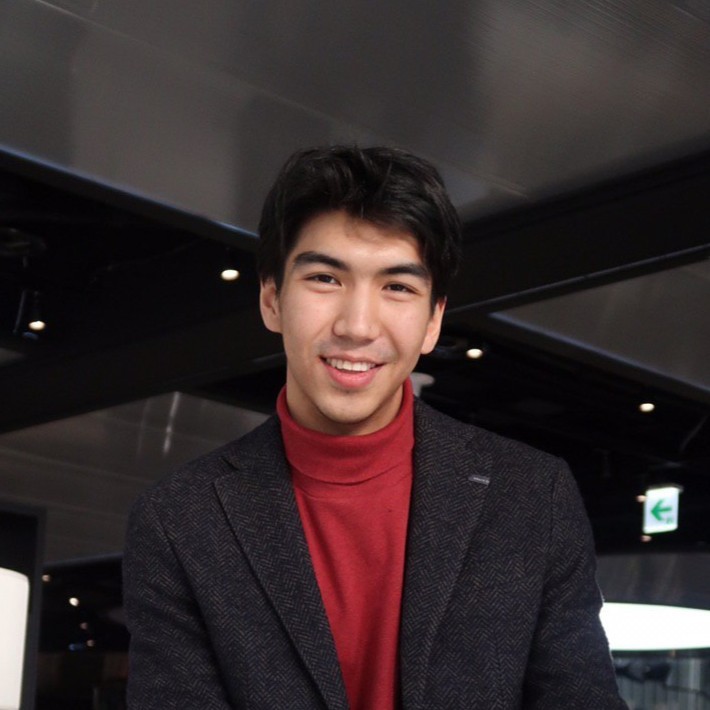
Shyngys Aitkazinov
Founder · M.Sc. Data Science, ETH Zürich
Trained at KAIST and ETH Zürich. Four years of shipping ML systems where the data is awkward and the cost of being wrong is real.
At Align Tech I built spatial-CNN pipelines that find margin lines on 3-D dental meshes — geometry-first ML, mesh in, landmarks out. At Lyceum Technology I shipped GPU-resource prediction for arbitrary deep-learning jobs straight from source code.
Before that, two years at Glassdome on production-grade anomaly detection over industrial sensor streams, plus an LLM-powered analytics chatbot that helped close two new clients. 3D-Medical is where that body of work meets the clinic.
Selected work